Biologically Effective Dose (BED) and EQD2: The FRCR Part 1 Calculation Guide
Master BED and EQD2 calculations using the linear-quadratic model. Step-by-step guidance with worked examples for FRCR Part 1 radiobiology questions.
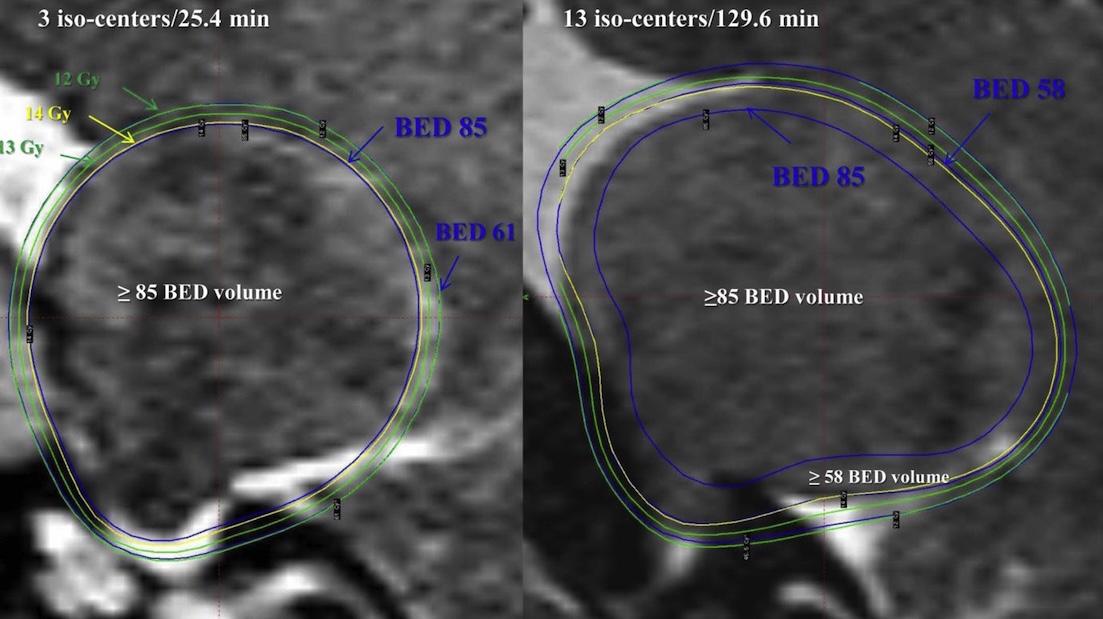
Biologically Effective Dose (BED) and Equivalent Dose in 2 Gy Fractions (EQD2) are essential radiobiology concepts that translate physical radiation doses into biologically meaningful values. These calculations appear frequently in FRCR Part 1 examinations and are fundamental to understanding fractionation.
The Linear-Quadratic Model Foundation
The linear-quadratic (LQ) model describes cell survival following radiation exposure:
Surviving Fraction: SF = e-(αD + βD²)
Where:
- α represents cell kill from single-hit (double-strand break) events - linear with dose
- β represents cell kill from accumulated sublethal damage - quadratic with dose
- D is the radiation dose
The α/β ratio is the dose at which linear and quadratic components of cell killing are equal. This ratio characterises tissue radiosensitivity:
- High α/β (~10 Gy): Early-responding tissues and most tumours
- Low α/β (~3 Gy): Late-responding normal tissues
- Very low α/β (1.5-2 Gy): Prostate cancer, some breast cancers
Biologically Effective Dose (BED)
BED quantifies the biological effect (log cell kill) of a radiation schedule, accounting for both dose and fractionation.
BED Formula: BED = nd × [1 + d/(α/β)]
Where:
- n = number of fractions
- d = dose per fraction (Gy)
- α/β = tissue-specific ratio (Gy)
Alternatively: BED = D × [1 + d/(α/β)] where D = total dose (nd)
Worked Example 1: Calculating BED
Question: Calculate the tumour BED for 60 Gy in 30 fractions (assume α/β = 10 Gy)
Solution:
- n = 30, d = 2 Gy, α/β = 10 Gy
- BED = 30 × 2 × [1 + 2/10]
- BED = 60 × [1 + 0.2]
- BED = 60 × 1.2 = 72 Gy₁₀
Note: BED is expressed as Gy followed by subscript indicating the α/β ratio used (Gy₁₀ or Gy₃).
Equivalent Dose in 2 Gy Fractions (EQD2)
EQD2 converts any fractionation schedule to the equivalent total dose if given in 2 Gy fractions. This allows direct comparison between different schedules and is widely used clinically.
EQD2 Formula: EQD2 = D × [(d + α/β)/(2 + α/β)]
Or alternatively: EQD2 = BED / [1 + 2/(α/β)]
Worked Example 2: Calculating EQD2
Question: Calculate the tumour EQD2 for 55 Gy in 20 fractions (α/β = 10 Gy)
Solution:
- D = 55 Gy, d = 2.75 Gy, α/β = 10 Gy
- EQD2 = 55 × [(2.75 + 10)/(2 + 10)]
- EQD2 = 55 × [12.75/12]
- EQD2 = 55 × 1.0625 = 58.4 Gy
Worked Example 3: Comparing Schedules
Question: A patient receives 40 Gy in 15 fractions to the breast. What is the late effect EQD2 (α/β = 3 Gy) and tumour EQD2 (α/β = 10 Gy)?
Late Effects (α/β = 3 Gy):
- d = 40/15 = 2.67 Gy
- EQD2 = 40 × [(2.67 + 3)/(2 + 3)]
- EQD2 = 40 × [5.67/5] = 40 × 1.134 = 45.4 Gy
Tumour (α/β = 10 Gy):
- EQD2 = 40 × [(2.67 + 10)/(2 + 10)]
- EQD2 = 40 × [12.67/12] = 40 × 1.056 = 42.2 Gy
Clinical Applications
Hypofractionation Rationale
When tumour α/β is lower than surrounding late-responding tissues (e.g., prostate cancer α/β ≈ 1.5-2 Gy), hypofractionation provides a therapeutic advantage by delivering higher BED to the tumour while maintaining acceptable late toxicity.
Treatment Interruption Corrections
If treatment is prolonged, tumour repopulation occurs. A repopulation correction can be added:
Corrected BED = BED - (0.693/α × Tₚ) × (T - Tₖ)
Where T = overall treatment time, Tₖ = kick-off time (onset of accelerated repopulation, typically ~28 days for HNSCC), and Tₚ = tumour potential doubling time.
Key α/β Values for FRCR Part 1
Tumours (typically high α/β):
- Most carcinomas: 10 Gy
- Head and neck SCC: 10-15 Gy
- Prostate adenocarcinoma: 1.5-2 Gy (exceptionally low)
- Breast cancer: 4-5 Gy
- Melanoma: 0.6-2.5 Gy
Late-Responding Normal Tissues (low α/β):
- Spinal cord: 2-3 Gy
- Lung (late): 3-4 Gy
- Rectum: 3-5 Gy
- Kidney: 2-3 Gy
Early-Responding Tissues (high α/β):
- Skin (acute): 8-12 Gy
- Mucosa: 8-15 Gy
- Bone marrow: 8-10 Gy
Limitations of the LQ Model
- May not accurately predict effects at very high doses per fraction (>8-10 Gy)
- Does not account for repopulation during treatment
- Assumes complete repair between fractions (minimum 6 hours required)
- α/β values have significant uncertainty
Key Exam Points
- BED = nd × [1 + d/(α/β)] - memorise this formula
- EQD2 = D × [(d + α/β)/(2 + α/β)] - memorise this formula
- High α/β (10 Gy): most tumours, early-responding tissues
- Low α/β (3 Gy): late-responding tissues, prostate cancer
- Lower α/β tissues are more sensitive to changes in fraction size
- Hypofractionation benefits tumours with low α/β ratios
Enjoyed this article?
Share it with a colleague preparing for their FRCR.